KOS publishes the work of Jamarlin Martin — a builder's library for Black American political science, culture, entrepreneurship, education, and artificial intelligence. Science over Spook. Data over dogma. Sovereign thinking over inherited scripts.
Our Founder and His Ventures Have Been Featured In
The New York TimesFinancial TimesFortuneGQJET MagazineEbonyAdvertising AgeInc. MagazineThe New York TimesFinancial TimesFortuneGQJET MagazineEbonyAdvertising AgeInc. Magazine
Spring Catalog
Three new arrivals.
03
No. 01
Available now
Political Science
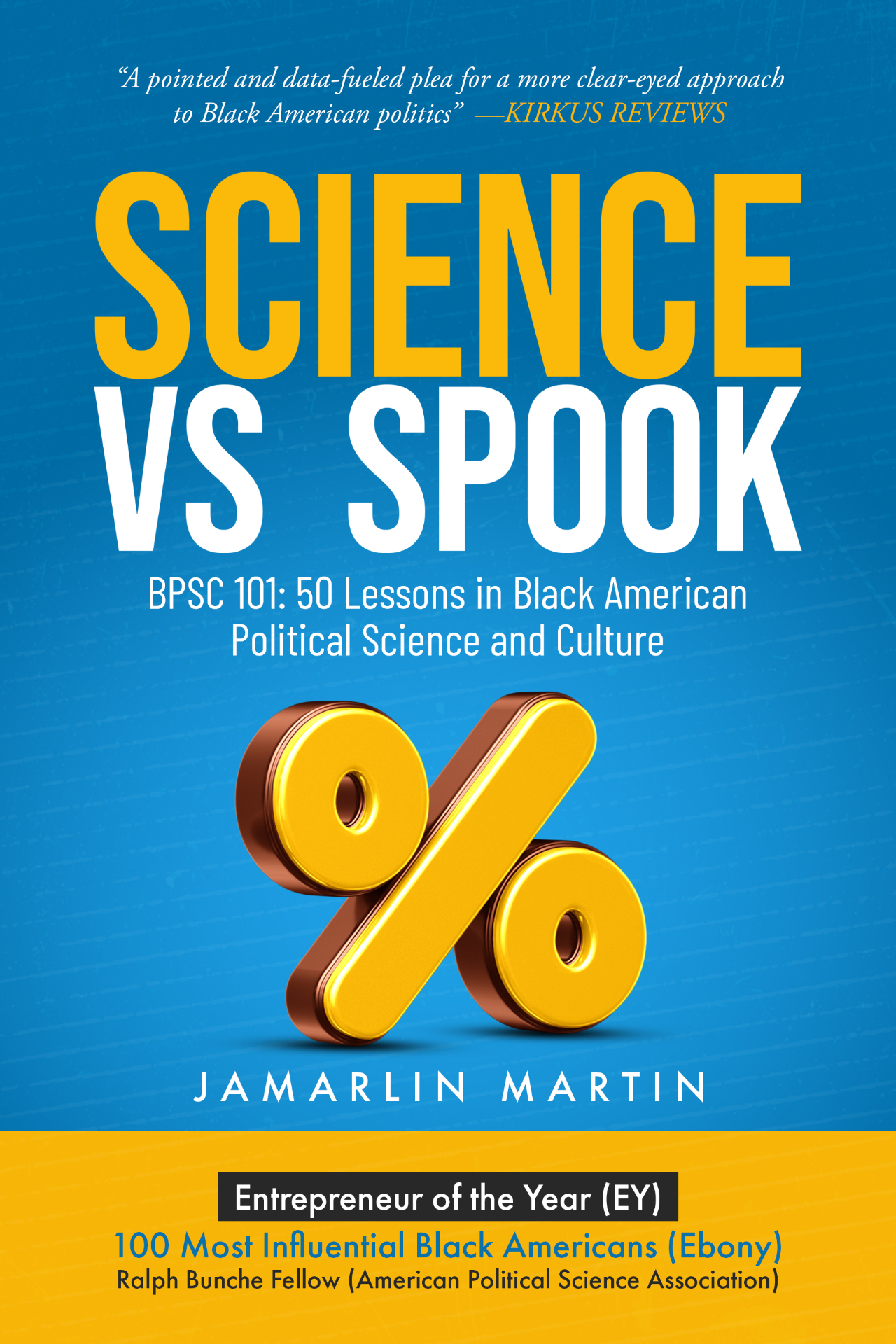
Science vs Spook
BPSC 101 — 50 Lessons in Black American Political Science & Culture
by Jamarlin Martin
Fifty lessons that separate demonstrable political science from 'spook' — the imaginary beliefs in leaders and movements that keep Black American politics stuck in symbolism over substance. Martin builds a data-fueled case for reparations, AI-driven strategy, and coalition politics that trades inherited scripts for sovereign thinking. A plea for clarity from a builder who has bet his own capital on the future.
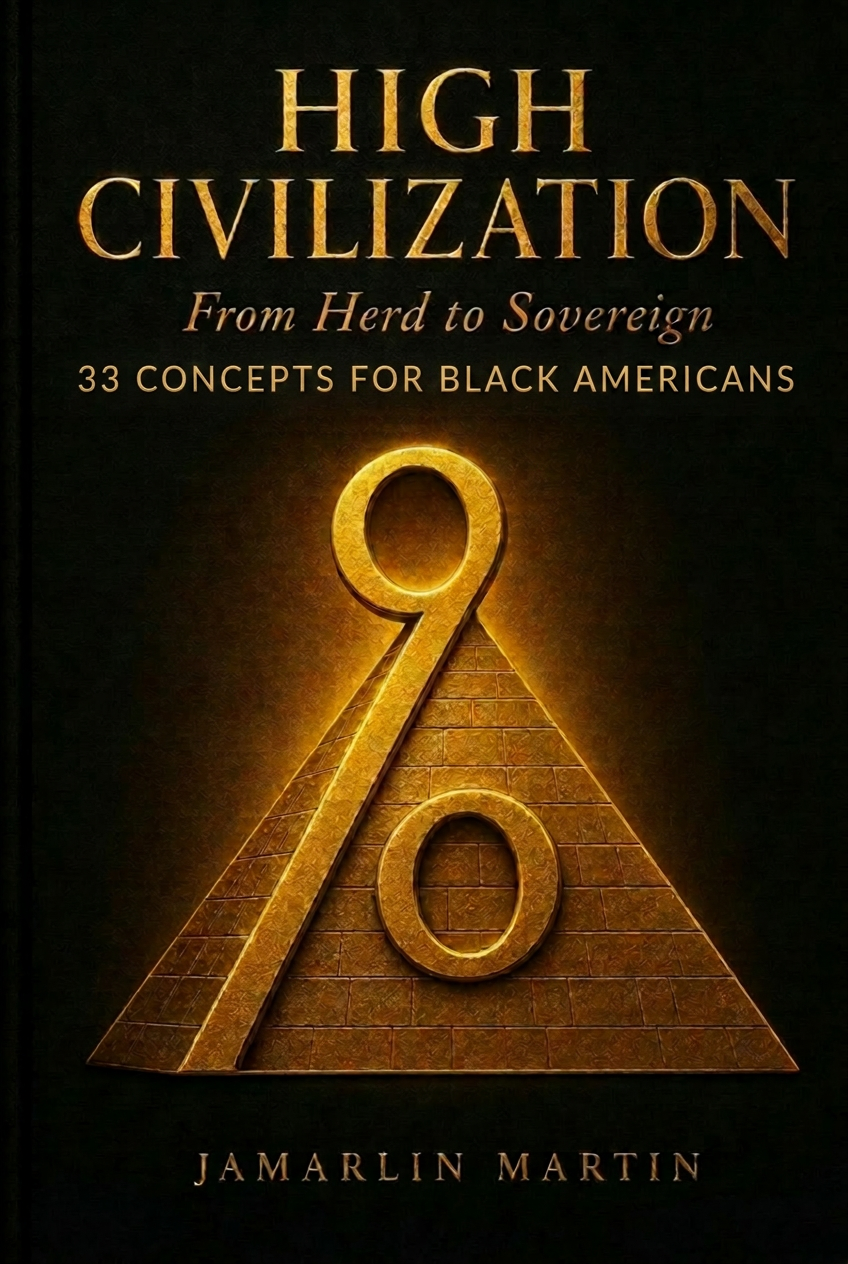
From Herd to Sovereign — 33 Concepts for Black Americans
by Jamarlin Martin
Most of us were taught what to think, not how to think. In High Civilization, Jamarlin Martin gives Black Americans 33 concepts — pattern recognition, conflicts of interest, factors, spreads, surgical thinking — to break herd conditioning and see what is actually happening. It is the same method he used to build a media company from a $6 domain name and to flag Silicon Valley Bank and FTX before they collapsed, and it works on a job offer, a mortgage, a campaign speech, a school, or an organization you want to build. High Civilization will teach you how to think independently, with higher-probability outcomes, like a Sovereign.
$32.99
No. 03
Feb 1, 2027
Memoir
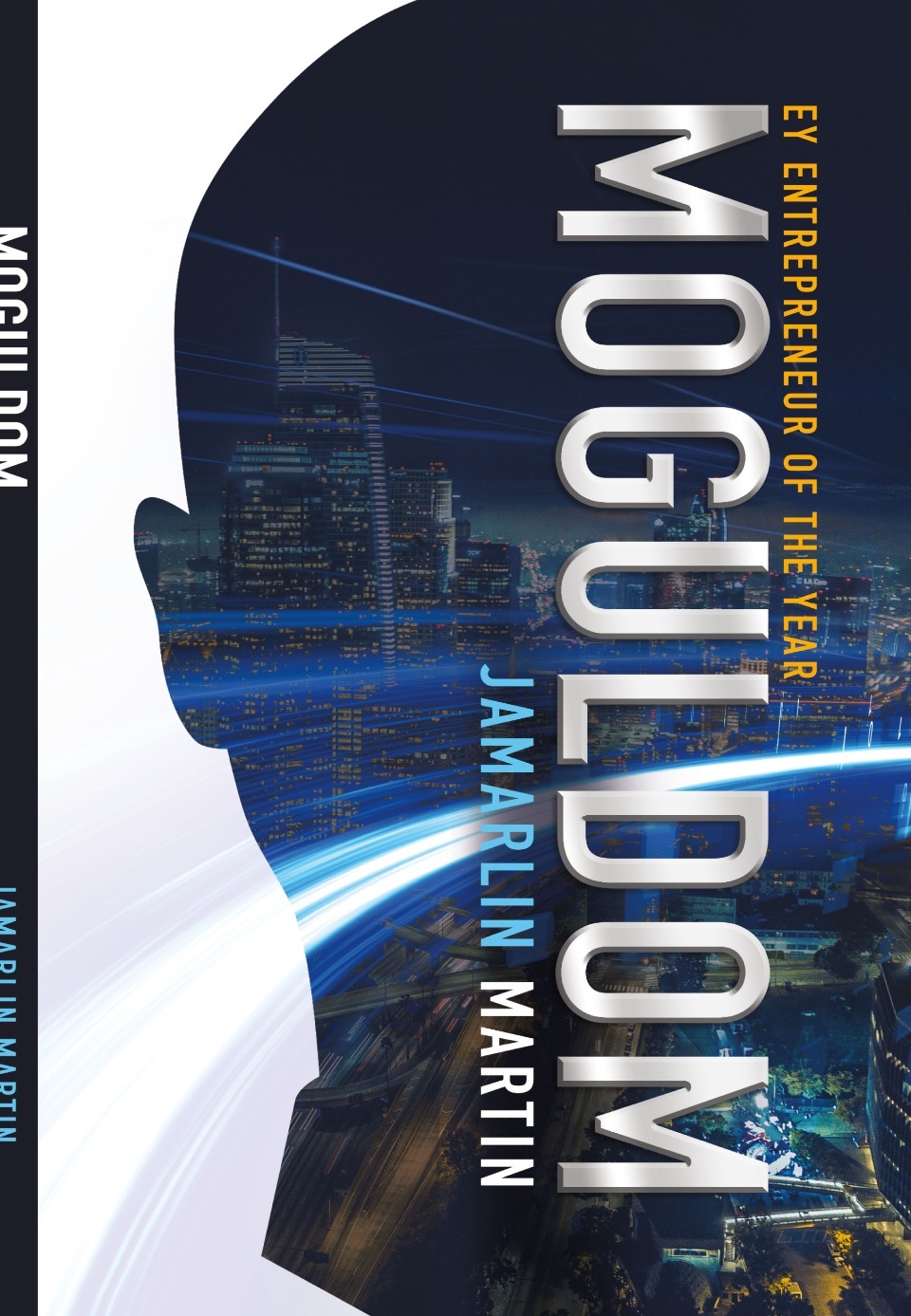
Moguldom
A Memoir — From the LA Projects to EY Entrepreneur of the Year
by Jamarlin Martin
From a roach-infested Norwalk townhouse and Mississippi plantation roots to a $60M digital media company built without venture capital. A Black American story of crack-era LA, Morehouse, Wall Street's underbelly, and the discipline it takes to turn $6 into Moguldom.
Praise for Science vs Spook
"
Martin discusses Black American political realities. In his debut work of nonfiction, the author immediately defines his terms and differentiates between established, demonstrable science (including political science) and what he refers to as "spook," defined here as "imaginary beliefs in people, leaders, and concepts that are far from what is real or scientific."
The Black American political renaissance Martin would like to see, one grounded in reality rather than the hope of "waiting for a white Jesus in the sky," needs more science and less symbolism, he argues — more analysis and less spook. One key tool for this renaissance, per the author, is artificial intelligence, which, he posits, "could help Black America leapfrog institutional and financial barriers"; Martin asserts that the technology is so important that "there is no political path into a political renaissance in Black America without AI."
One of Martin's primary concerns is financial reparations for the descendants of Black slaves brought to North America in chains. "When politicians offer us cultural or identity-based recognition," the author writes, "we must demand economic transformation."
Martin uses science and AI-guided calculations to make his case that all of the descendants of Black slaves are owed very substantial reparations in order to counter the "persistent economic inequality" that shapes Black American reality today. Each of the book's 50 chapters presents a compelling discussion of a different aspect of Martin's subject, from the rise of the Black Lives Matter movement (which "involves both organizational challenges and legitimate concerns about transparency and grift") to the complexities of coalition politics between Black Americans and, for instance, Mexican-Americans.
The author builds a powerful argument for an information-driven approach to addressing systemic racism. A pointed and data-fueled plea for a more clear-eyed approach to Black American politics.
Our Founder & Author
Jamarlin Martin
Founder & CEO, KOS Book Publishing, LLC.
Jamarlin Martin at the Million Man March, Washington, D.C., 1995. The bus trip inspired Spike Lee's Get on the Bus.
Martin caught the bus by himself in the Leimert Park section of South Central Los Angeles. The bus trip inspired the movie Get on the Bus, about a group of Black men traveling to the Million Man March from South Central.
Jamarlin Martin is a Black American business owner (descendant of slaves in Mississippi and Louisiana) residing in Florida and founder/CEO of KOS Book Publishing, LLC. Prior to his successful digital media career, Martin graduated from Morehouse College. He attended Syracuse University College of Law and worked as a contract paralegal at Paul, Weiss on the famous Jack Grubman–Salomon Smith Barney case involving conflicts of interest.
Learning from his experience analyzing Grubman's emails, he developed expertise in identifying fraudulent conflict structures and later flagged the relationship between FTX and Alameda Research — identifying brokerage and proprietary trading conflicts as predictive of massive fraud years before the case made history. After commissioning an article exposing these conflicts, Dan Friedberg, Chief Counsel for FTX and Alameda, wanting to discuss his concerns, demonstrating his prescient ability to identify systematic fraud in complex financial structures.
The same pattern-recognition skills produced another historic call. In an August 8, 2017 article, Martin publicly named Silicon Valley Bank as ground zero for a popping Silicon Valley bubble — making him the first American to publicly flag the risks related to SVB. He submitted the short thesis to Seeking Alpha for syndication, but its editors . Six years later, in March 2023, Silicon Valley Bank collapsed, federal regulators and the Federal Reserve intervened with emergency measures to contain the fallout, and SVB Financial Group filed for bankruptcy. FTX and SVB tell one pattern story: the same trained eye that spotted crypto's largest fraud also spotted what became, at the time, the second-largest bank failure in U.S. history — years before either made headlines.
Martin has also previously worked as an independent contractor at McKinsey & Company. He is a recognized expert in paid discovery marketing. He is an EY Entrepreneur of the Year award recipient, named to Ebony Magazine's 100 Most Influential Black Americans, featured in Fortune Magazine's David vs Goliath column, and was an American Political Science Association Ralph Bunche Fellow studying graduate-level political science courses as an undergraduate at the University of Virginia.
In 2013, Inc. Magazine named Martin's company Moguldom Media Group the 11th-fastest-growing media company in the United States in its Inc. 5000 ranking. While pioneering digital analytics science and developing audiences for blogs, he built a portfolio of blogs with over 20 million monthly users and $20 million in annual revenue before selling his portfolio to Nasdaq-listed Urban One. Martin started his digital media career with a $6 GoDaddy domain name purchase and built his empire without venture capital.
Martin independently ran a multi-year, intelligence-grade investigation into the $140 billion global ad fraud industry — work that began before his February 2024 Securities and Exchange Commission whistleblower submission and continued after it. He applied the same discipline and analytical and data-science rigor that built his digital media business to the fraud that resulted in big advertisers such as Target, Amazon, and AT&T pulling their ad spend. His research was augmented with artificial intelligence and pointed to intelligence-linked and state-sponsored corporate fraud at American companies. The investigation uncovered systematic ad fraud — and elevated risks of obstruction and conflicts of interest involving his paid legal representation.
We also do this
Digital Media & AI Strategy Consulting.
Publishing is the core of KOS — but on a selective basis we also advise founders, operators, and institutions on digital media strategy and AI-driven growth. Audience building, paid discovery, analytics, and applied AI workflows drawn from two decades of operating experience.
Engagements are limited and by referral. If your team is wrestling with an audience, media, or AI strategy problem worth solving,get in touch.
Press Spotlight
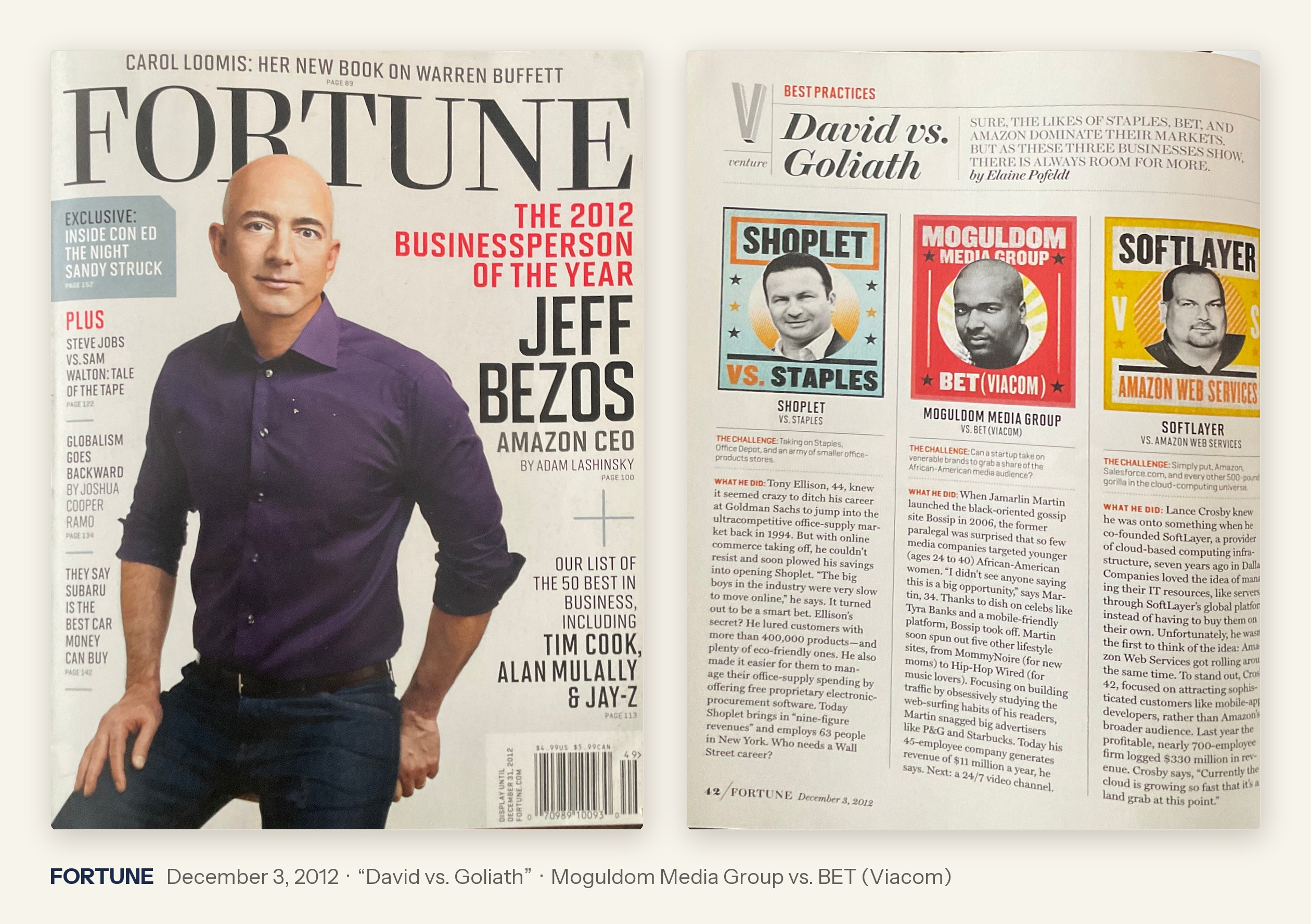
Fortune Magazine, David vs. Goliath.
December 3, 2012 · Page 42 · by Elaine Pofeldt
Moguldom Media Group vs. BET (Viacom)
The Challenge: Can a startup take on venerable brands to grab a share of the African-American media audience?
What He Did: When Jamarlin Martin launched the black-oriented gossip site Bossip in 2006, the former paralegal was surprised that so few media companies targeted younger (ages 24 to 40) African-American women. "I didn't see anyone saying this is a big opportunity," says Martin, 34. Thanks to dish on celebs like Tyra Banks and a mobile-friendly platform, Bossip took off. Martin soon spun out five other lifestyle sites, from MommyNoire (for new moms) to Hip-Hop Wired (for music lovers). Focusing on building traffic by obsessively studying the web-surfing habits of his readers, Martin snagged big advertisers like P&G and Starbucks. Today his 45-employee company generates revenue of $11 million a year, he says. Next: a 24/7 video channel.
Stay in the loop
News & updates from KOS Book Publishing.
New titles, pre-order windows, author essays, and behind-the-scenes from the press. No spam — just the work.